Norway joined NATO in 1949 after World War II reshaped its security priorities. Learn how wartime occupation, proximity to the Soviet Union, Arctic strategy, and collective defense influenced the decision.
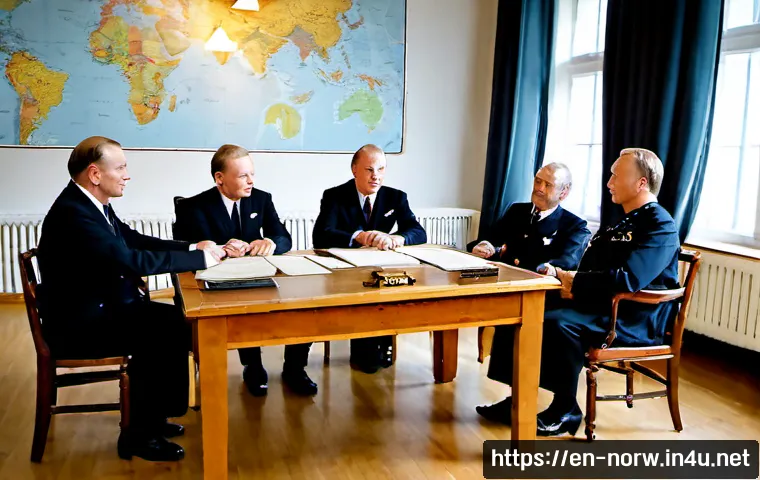
Norway joined NATO in 1949 because World War II undermined confidence that neutrality alone could protect the country. German occupation, uncertainty in Northern Europe, proximity to the Soviet Union, and Norway’s North Atlantic location all strengthened the case for collective defense.
The decision was not necessarily driven by one single motive; security, diplomacy, domestic debate, and relations with Western partners overlapped. For students and researchers, the best explanation is one that compares the available alternatives rather than treating NATO membership as inevitable.
Reliable books, university courses, archival collections, and research databases can help test competing interpretations.
At a Glance
- Norway’s wartime occupation made earlier assumptions about neutrality appear less secure after 1945.
- Collective defense through NATO offered a broader security framework than Norway could provide by itself.
- Norway’s Soviet proximity and North Atlantic–Arctic position made regional security questions especially important.
| Post-war option | Potential benefit | Key limitation or risk | Decision factor to examine |
|---|---|---|---|
| Continuing neutrality | Could preserve formal distance from major-power blocs. | Its credibility was questioned after the experience of wartime occupation. | Whether neutrality could be defended in a new European security environment. |
| Scandinavian defense cooperation | Could emphasize regional ties and shared Nordic interests. | Its practical security guarantees and outside support required careful assessment. | Whether regional cooperation could provide sufficient deterrence. |
| NATO membership | Connected Norway to a collective-defense alliance with Western partners. | Required political alignment and carried strategic consequences. | Whether alliance commitments offered stronger protection than other choices. |
The Short Answer: Why Norway Chose Collective Defense in 1949
From traditional neutrality to a new post-war security calculation
Norway’s move into NATO is often explained as a shift from traditional neutrality toward a more formal system of collective security. The central point is not that neutrality suddenly became meaningless, but that the post-war environment made its limits harder to ignore. The German occupation during World War II showed that formal nonalignment did not automatically prevent invasion or guarantee outside assistance.
After the war, Norwegian decision-makers faced a different strategic setting. Europe was unsettled, the relationship between Western states and the Soviet Union was increasingly tense, and Norway had to consider its position in Northern Europe. A balanced explanation should therefore connect wartime experience with post-war uncertainty. It should not reduce the decision to a single speech, event, or fear.
Why NATO offered a stronger security guarantee than Norway could provide alone
NATO offered Norway participation in a wider collective-defense framework. For a country assessing its security after occupation, the attraction was not simply military strength in the abstract. It was the prospect of being tied to partners whose security interests were connected to Norway’s own.
This did not make the choice cost-free. Membership also meant closer political alignment with Western allies and a greater role in the strategic questions of the North Atlantic and Arctic regions. When reading a historical account, look for whether it explains both sides: the appeal of stronger external support and the trade-offs involved in joining an alliance.
The Events That Changed Norway’s Security Outlook
The impact of the German occupation during World War II
The wartime occupation was a major reference point in Norway’s post-war security thinking. It challenged the assumption that a smaller state could remain secure simply by staying outside conflict. That experience did not mechanically dictate NATO membership, but it gave new weight to arguments that security required dependable partners and advance planning.
Good historical writing distinguishes between experience and inevitability. Occupation mattered because it reshaped the questions policymakers asked: What happens if neutrality is ignored? Who provides support? What kind of security arrangement can be trusted in a crisis?
Post-war uncertainty in Northern Europe and the High North
Norway had to evaluate security in a region where geography mattered greatly. Its long northern area, access to the North Atlantic, and place in the High North linked domestic security to wider European and maritime concerns. These longer-term considerations complemented the immediate memory of war.
It is useful to separate two time horizons. The first was the urgent post-war concern about vulnerability and uncertainty. The second was the enduring strategic importance of the North Atlantic and Arctic. A strong explanation shows how these horizons could reinforce one another without claiming that every policymaker ranked them in exactly the same way.
Security concerns linked to Norway’s proximity to the Soviet Union
Norway’s proximity to the Soviet Union was another important part of the security debate. Geographic closeness could not be treated as a purely local issue; it was connected to the broader development of Cold War security arrangements. For Norwegian leaders, proximity likely raised practical questions about warning, deterrence, diplomacy, and the reliability of external support.
Still, readers should be cautious with simplified claims such as “Norway joined NATO only because of the Soviet Union.” The available framework supports Soviet-related security concerns as a relevant factor, but the relative importance assigned by individual policymakers requires verification through archival evidence, speeches, correspondence, and careful historical scholarship.
Comparing Norway’s Main Security Options After the War
Continuing neutrality: advantages and limits
Neutrality had an understandable appeal. It could appear to reduce entanglement in great-power rivalry and preserve room for independent diplomacy. In the late 1940s, however, Norway also had to consider whether a neutral position would provide meaningful protection if its territory or surrounding waters became strategically significant.
The key limitation was credibility. The occupation experience had demonstrated that declaring neutrality was not the same as ensuring security. When evaluating a textbook or research paper, check whether it explains this distinction clearly rather than presenting neutrality as either foolish or fully sufficient.
A Scandinavian defense arrangement: why it was considered
A Scandinavian defense arrangement was a realistic subject of discussion because regional cooperation could build on shared geography and political connections. It offered a possible middle course between complete neutrality and entry into a wider Atlantic alliance.
Its appeal should not be dismissed. At the same time, the decisive question was whether such an arrangement could offer the scale, political backing, and security assurance Norway believed it needed. The best sources compare this option on its own terms instead of treating it as a brief footnote before an already predetermined NATO outcome.
NATO membership: collective defense, political alignment, and trade-offs
NATO membership placed Norway within a broader Western security system. The attraction was collective defense: security would be approached as a shared alliance responsibility rather than as a national task carried alone. This was particularly relevant for a country considering the lessons of occupation and its strategic geography.
The trade-off was that membership involved political alignment as well as defense planning. Norway’s choice should therefore be understood as a decision among imperfect alternatives. It was not simply a choice between safety and danger; it involved judging which framework offered the most credible response to a changing international environment.
What Joining NATO Meant for Norway
The importance of Article 5 and alliance-based deterrence
Article 5 is commonly associated with NATO’s collective-defense principle. In an explanation of Norway’s 1949 decision, its importance lies in the idea that an attack on one member would be treated as a concern for the alliance. That principle helped make NATO different from a purely diplomatic association.
For formal treaty language, dates, and legal interpretation, consult the treaty text and a reputable academic reference source. Avoid relying on short summaries alone, especially when a course assignment or policy paper requires precise wording.
Norway’s role in North Atlantic and Arctic security

Norway’s location gave it relevance in both North Atlantic and Arctic security discussions. Joining NATO linked that geography to a wider alliance perspective. The country was not merely choosing an abstract foreign-policy label; it was making a decision shaped by where it was located and how its region might matter in a larger conflict.
Modern readers should avoid automatically projecting present-day deployments, defense budgets, or policies backward onto 1949. Current security claims require confirmation from official and up-to-date sources. Historical analysis is strongest when it keeps the late-1940s context distinct from later developments.
Common oversimplifications to avoid when explaining the decision
Several shortcuts can weaken an otherwise good explanation. One is saying Norway was forced into NATO, which overlooks the existence of alternatives and domestic choice. Another is claiming that only Soviet proximity mattered, while ignoring occupation, alliance considerations, regional options, and North Atlantic strategy.
A third mistake is treating NATO membership as inevitable. Historical outcomes can later look obvious because they happened. A more careful approach asks what Norwegian policymakers knew at the time, which options they considered credible, and what uncertainties they still faced.
How to Evaluate Historical Claims and Research Resources
A checklist for assessing textbooks, archives, and policy analysis
Use a simple checklist before accepting a claim about Norway’s NATO decision. First, identify the author’s expertise in Norwegian history, Cold War history, or security studies. Second, check whether the work cites primary sources, including official records, correspondence, parliamentary material, or contemporary documents.
Third, examine the publication date and edition. Older works may remain valuable, but newer scholarship may incorporate additional archival material or revised interpretations. Fourth, distinguish between a source that explains evidence and one that merely repeats a conclusion. Finally, compare more than one credible source when a claim assigns a precise motive to a specific policymaker.
When a university course, specialist book, or research subscription adds value
A general history book may be enough for an introductory overview. A university course can add value when you need structured chronology, guided readings, and discussion of competing interpretations. A specialist book may be more useful when your focus is Norwegian foreign policy, Nordic defense cooperation, or Arctic geopolitics.
Research databases and academic reference subscriptions are most useful when you need peer-reviewed articles, archival guides, or detailed citation trails. Before choosing a paid resource, check the author information, source list, publication date, and access to primary materials. For a book, course, archive, or database, review the syllabus, preview pages, and source coverage on the provider’s official page.
Choosing the Best Explanation: A Decision-Stage Summary
The most balanced way to explain Norway’s NATO decision
The clearest explanation is that Norway joined NATO in 1949 after reassessing security in light of wartime occupation and post-war uncertainty. NATO appeared to offer a more credible collective-defense structure than neutrality alone, while Norway’s Soviet proximity and North Atlantic–Arctic geography made the broader strategic setting difficult to ignore.
Keep one qualification in view: no single factor should automatically be presented as definitive. The balance among security concerns, domestic politics, economic recovery, and relations with Western allies may differ across archival interpretations. A careful answer states the major pressures, compares the alternatives, and acknowledges what requires further evidence.
Research-resource comparison criteria for students and serious readers
Before selecting a history course, academic book, archive collection, or geopolitical research database, check these points:
- Scope: Does it cover Norway, Nordic security, NATO, and the early Cold War rather than only one topic?
- Author expertise: Is the author or instructor qualified in the relevant historical field?
- Evidence: Does the resource use citations and explain its primary-source base?
- Currency: Is the edition or database updated enough for your research purpose?
- Depth: Does it distinguish fact, interpretation, and unresolved scholarly debate?
If you need to make a research-resource choice, compare the source list, instructor credentials, archive access, and search tools before subscribing or enrolling.
Conclusion
Norway’s 1949 NATO decision is best understood as a response to a changed security environment rather than a simple rejection of its past. Wartime occupation altered how neutrality was viewed, while collective defense offered a wider framework for dealing with post-war uncertainty. Geography also mattered, especially Norway’s relationship to the North Atlantic, Arctic, and Soviet proximity.
The strongest historical account compares NATO membership with the alternatives that were genuinely discussed. It also avoids claiming more certainty about individual motives than the evidence can support.
Useful Information to Keep in Mind
Timeline matters. Separate the wartime occupation, immediate post-war uncertainty, and the longer-term strategic importance of the High North.
Terms matter. Neutrality, collective defense, deterrence, and political alignment are related but not interchangeable ideas.
Sources matter. For treaty provisions and archival interpretations, verify the original document or use a well-cited academic source.
Important Notes
This overview is a general guide rather than a substitute for archival research. Exact dates, treaty wording, and claims about the motives of individual Norwegian policymakers should be checked against reliable primary sources and current academic scholarship. Present-day defense or security-policy claims should not be inferred from this historical discussion without official confirmation.
Frequently Asked Questions
Q1. Was Norway forced to join NATO in 1949?
A1. Norway’s decision should not be described simply as forced. The country faced serious security pressures and difficult alternatives, but neutrality and Scandinavian defense cooperation were also considered. NATO membership emerged from a political decision made in a changing post-war environment.
Q2. Why did Norway move away from its earlier tradition of neutrality?
A2. The German occupation during World War II raised doubts about whether neutrality alone could provide security. After the war, uncertainty in Northern Europe, concern about Soviet proximity, and the appeal of collective defense made a wider alliance framework more attractive.
Q3. Was a Scandinavian defense union a realistic alternative to NATO membership?
A3. Yes, it was a meaningful alternative to consider. Its central challenge was whether regional cooperation could provide security guarantees strong enough for Norway’s post-war concerns. A careful historical account should analyze it as a genuine option rather than assume NATO was the only possible outcome.